
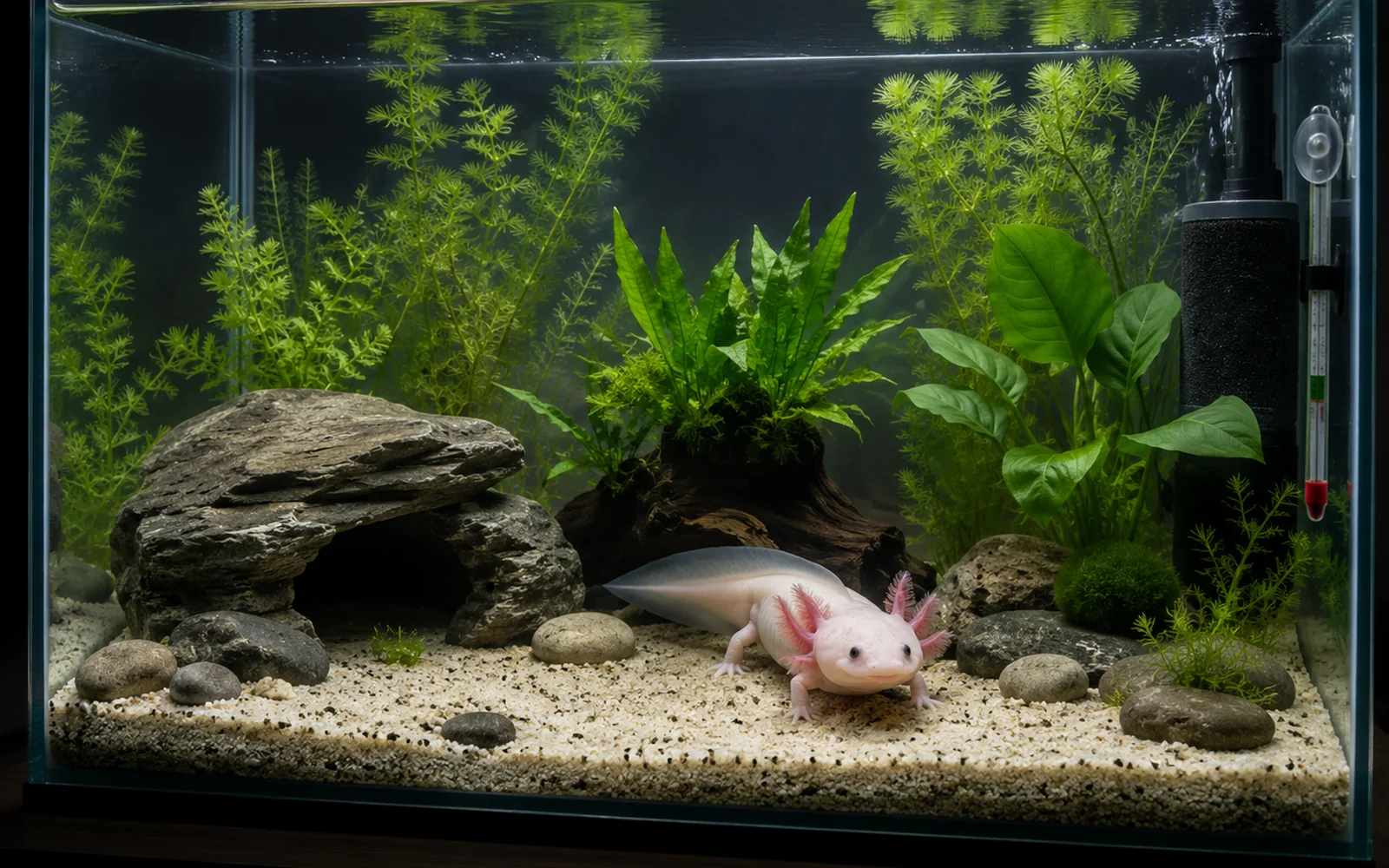
The best axolotl tank is wide, cool, fully cycled and easy to clean. For one adult, use at least 29 gallons / 110 liters, with a 40 gallon breeder-style footprint being easier and more forgiving.
Tank size and footprint
Axolotls use the bottom of the aquarium more than the vertical water column. That means footprint matters. A wide tank gives the animal more walking space, room for hides and more stable water volume. A tall narrow tank may look impressive but can be less useful because the extra height does not solve floor-space or waste-dilution problems.
Small tanks also punish beginners. A missed leftover worm, a dirty filter sponge or one warm day can push water quality in the wrong direction faster in a small aquarium. Larger water volume does not replace maintenance, but it gives you more stability and more time to notice problems.
| Setup | Use case | Verdict |
|---|---|---|
| 10 gallon | Temporary emergency tub or very short-term juvenile housing | Not a good adult home |
| 20 gallon long | Sometimes used by experienced keepers | Tight and less forgiving |
| 29 gallon | One adult with careful maintenance | Practical minimum |
| 40 gallon breeder-style | One adult with better floor space and stability | Recommended beginner target |
Equipment that matters
The essential equipment is not flashy. You need a filter that can hold beneficial bacteria, a thermometer you trust, water conditioner, a liquid test kit, a lid, a siphon, a dedicated bucket and smooth décor. Strong lights, tropical heaters, sharp plastic plants and gravel are usually more risk than benefit.
Filtration should be effective but gentle. Sponge filters are popular because they create less harsh current and provide biological filtration. Canister or hang-on-back filters can work when the output is baffled. The goal is not a powerful river; the goal is clean water without pushing the axolotl around.
Substrate and décor
Unsafe substrate is a preventable problem. Gravel and small stones can be swallowed and cause impaction. Bare bottom is easy to clean but can be slippery and visually plain. Very fine sand is commonly used for larger juveniles and adults when kept clean, but it must not be coarse or full of sharp fragments.
Every hide should have smooth edges and an opening large enough for the axolotl to enter and leave without scraping gills. Décor should be stable so it cannot collapse. Avoid decorations with small holes where limbs or gills can get trapped.
Cooling plan before summer
Temperature is part of tank setup, not a problem to solve after a heatwave starts. Choose the tank location carefully: away from direct sunlight, radiators, warm windows and electronics that heat the room. Many keepers use fans, cooler rooms or chillers depending on climate. If your home regularly becomes warm, plan the solution before buying the animal.
Beginner-safe layout example
- Open walking space across the front.
- One large hide on each side of the tank.
- Filter intake protected and output softened.
- Thermometer visible from the front.
- Low-light plants such as anubias or java fern attached safely.
- No gravel, sharp rocks, small shells, metal décor or bright exposed lighting.
Set up before buying the axolotl
The tank should be assembled, filled, dechlorinated, cycled and tested before the animal arrives. A stable setup makes the first week much calmer. If you buy the axolotl first, you may be forced into emergency tubbing, daily water changes or an uncycled aquarium. Those options can work in emergencies, but they are not the ideal start.
Next steps: read how to cycle an axolotl tank, then use the water parameter checker before adding the animal.
You can still make the tank look good. Choose large smooth stones that cannot be swallowed, wood or caves without sharp openings, low-light plants that tolerate cool water, and open sand or bare-bottom paths. Place hides so the axolotl can rest away from light and current. The best display tanks look calm because they are designed around the animal’s movement, not around filling every empty space.
Aquascaping without increasing risk
If you started with a small tank, do not waste money trying to make it perfect. Use it only as a temporary holding or quarantine option and move your budget toward a larger cycled aquarium. Keep the filter media alive if possible, because mature biological media can help seed the new setup. Move slowly, test often and avoid changing everything at once while the animal is already stressed.
Upgrade path if you already bought the wrong tank
Many aquarium photos look attractive but are not axolotl-safe. When you see a setup online, ignore the aesthetic first and check the welfare signals: Is there enough floor space? Is the substrate swallowable? Are there sharp edges? Is there a lid? Is the filter output too strong? Is the tank sitting in direct sunlight? Are there fish in the tank? A beautiful unsafe tank is still unsafe.
How to judge a setup photo online
Most tank photos online are taken to look good, not to prove the setup is healthy. Before copying one, check the things a single photo can hide. Is the tank long and low with real floor space, or tall and narrow? Is the substrate bare or fine sand rather than gravel an axolotl could swallow? Is there a gentle filter and a secure lid, or just an open tank with strong flow? Are there hides, or only decorations chosen for the camera? A clean-looking tank can still be uncycled, too warm or too small, so treat photos as inspiration for layout and always check the numbers and equipment behind the picture.
Related setup questions
- Best Tank Size for One Axolotl
- Is a 40 Gallon Breeder Good for an Axolotl?
- Bare Bottom vs Sand for Axolotls
- What Filter Is Best for Axolotls?
- Do Axolotls Need a Tank Lid?
Related: learn keep the tank cool in summer.