
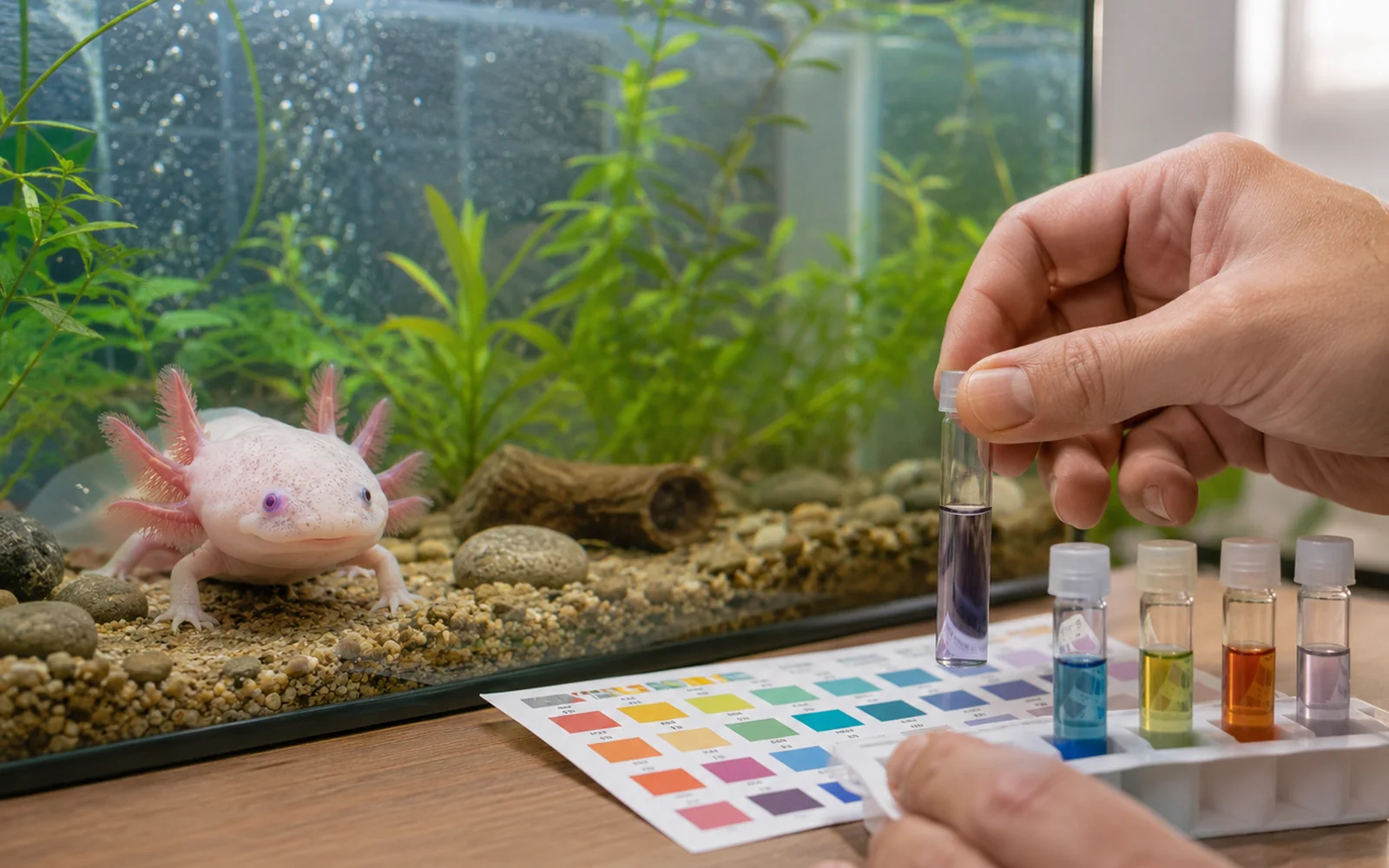
For axolotls, ammonia should be 0 ppm, nitrite should be 0 ppm, nitrate should be kept low with regular water changes, and temperature should stay cool, around 60–68°F / 16–20°C. Test with a liquid kit and act on readings, not guesses.
Safe target ranges
Water quality is the center of axolotl care because the animal lives inside the water that receives its waste. Even when the tank looks clear, ammonia or nitrite can be present. Clear water is not the same as safe water.
| Parameter | Target | Why it matters |
|---|---|---|
| Ammonia | 0 ppm | Toxic waste product; should not be present in a cycled tank |
| Nitrite | 0 ppm | Toxic intermediate in the nitrogen cycle |
| Nitrate | Low — aim under ~40 ppm | Builds up over time and is reduced by water changes |
| Temperature | 60–68°F / 16–20°C, stable | Warm water increases stress and makes problems worse |
| pH | ~7.4–7.6, stable | Sudden pH change can stress aquatic animals |
| Hardness (GH/KH) | Moderate and stable | Some carbonate hardness (KH) helps buffer pH; very soft water swings easily |
Testing routine
A new tank should be tested frequently. A mature, stable tank can usually be tested weekly, but any change should reset your caution level. Test after a new animal arrives, after filter maintenance, after unusual behavior, after missed water changes and after any suspected food rot.
Liquid test kits are preferred for decision-making because they give clearer ammonia, nitrite and nitrate readings. Keep a simple log with date, temperature and readings. This turns vague concern into a pattern you can act on.
What readings mean in practice
If ammonia or nitrite is above 0 ppm, treat that as a warning sign. The filter may not be cycled, the bioload may be too high, the tank may be too small, food may be rotting, or beneficial bacteria may have been damaged. Do not solve this by adding random chemicals without understanding the cause.
High nitrate is usually handled through partial water changes, better cleaning, less overfeeding, more water volume and healthier maintenance habits. Nitrate does not appear out of nowhere; it is the end product of waste processing.
Water changes without shocking the tank
Water changes remove nitrate and dissolved waste. Match the new water temperature as closely as practical, use the correct dechlorinator, and avoid disturbing the filter media aggressively. A partial water change is usually safer than tearing the whole tank apart.
- Use a dedicated aquarium bucket only.
- Condition tap water before it goes into the tank.
- Vacuum waste from the substrate surface.
- Do not rinse biological filter media under untreated tap water.
- Retest after big changes or any emergency correction.
Common water problems
Cloudy water can be bacterial bloom, disturbed substrate, overfeeding or a cycling issue. Bad smell often points to rotting food, trapped waste or poor maintenance. Recurring nitrate may mean the tank is too small, overfed, under-cleaned or under-filtered for the animal’s waste load.
Use the water parameter checker as a conservative second pass after you test. It does not replace experience, but it helps beginners decide whether a reading is normal, cautionary or urgent.
Water products: what to be careful with
Dechlorinator is essential when using chlorinated tap water. Beyond that, be cautious. Bottles that promise instant fixes can confuse beginners and may not address the underlying problem. The long-term solution is usually correct cycling, correct stocking, better cleaning, more water volume and stable temperature. Additives should never be used as a substitute for understanding ammonia, nitrite and nitrate.
Be especially cautious with any additive, and test before and after, in these situations:
- During cycling.
- For the first two weeks after adding the axolotl.
- After a missed water change or heavy feeding.
- After a filter stops, clogs or is cleaned.
- When the animal floats, refuses food, swims frantically or shows gill changes.
- During heatwaves or room-temperature swings.
When to test more often
One water test is a snapshot. A log is a story. If nitrate climbs quickly every week, the tank may be overfed, too small or under-maintained. If ammonia appears after filter cleaning, the cleaning method may be damaging bacteria. If pH swings after water changes, compare tap water and tank water. Patterns help you fix causes instead of repeatedly treating symptoms.
How to read patterns, not just numbers
A single set of readings only tells you where the tank is right now. The real skill is watching how those numbers move over days and weeks. Nitrate that climbs a little every week points to feeding or maintenance, not a single bad day. Ammonia that only appears after you clean the filter usually means the cleaning is killing bacteria. A pH that drifts down slowly over time often means the tank is running low on buffering and needs attention before it swings. Keep dated readings in one place and look for the trend — the pattern is what tells you what to fix, while one number on its own can send you chasing the wrong problem.
Related water questions
- Ammonia in an Axolotl Tank
- Nitrite in an Axolotl Tank
- Nitrate Levels for Axolotls
- Axolotl Water Temperature
- How Often Should You Change Axolotl Water?
Related reading: safe nitrate levels and how often to change the water.