
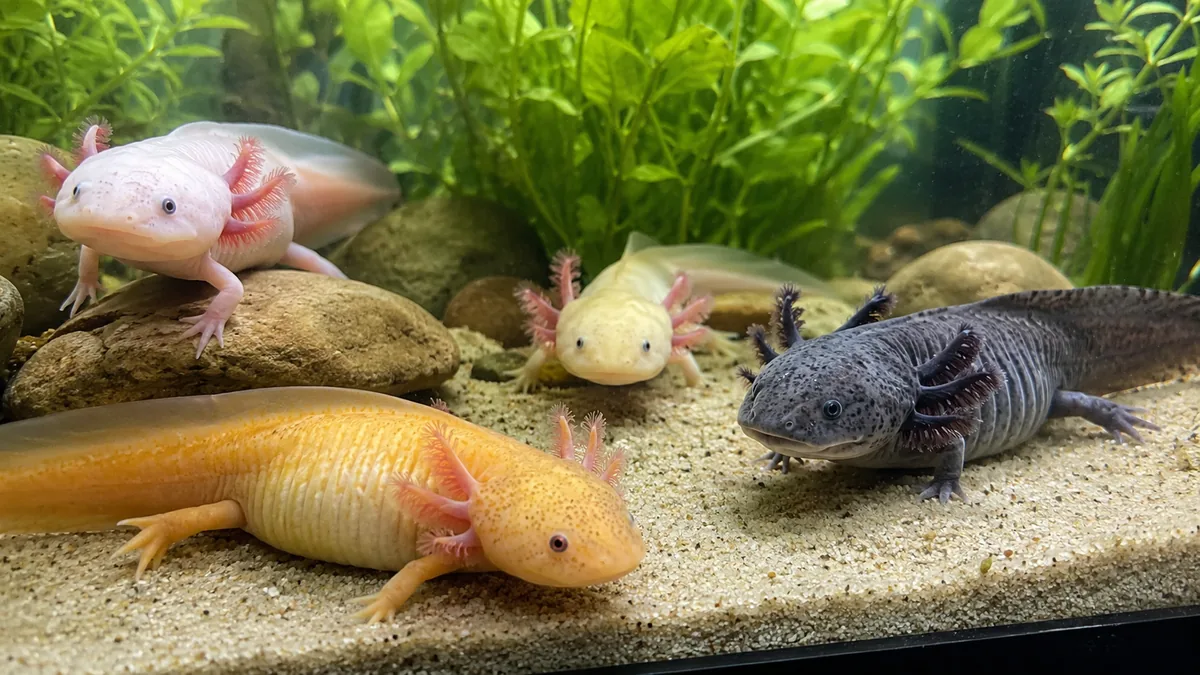
Axolotl morphs are color and pattern variations such as leucistic, wild type, golden albino, white albino, melanoid and GFP lines. Morph affects appearance, not the basic care requirements.
Common axolotl morphs
Most beginners first notice the pink leucistic axolotl, but pet axolotls come in several appearances. Wild type animals are darker and mottled. Golden albinos are yellow or gold-toned. Melanoids are dark with less reflective pigment. GFP animals may glow under specific blue/UV lighting because of a genetic marker used in some lines.
| Morph | Typical look | Beginner note |
|---|---|---|
| Leucistic | Pale pink/white body, dark eyes, pink gills | Very popular and easy to recognize |
| Wild type | Olive, brown, grey or mottled | Closer to natural camouflage appearance |
| Golden albino | Yellow/gold body, pale eyes | Bright color; still needs dim care |
| Melanoid | Dark charcoal/black look | Color does not mean stronger health |
| GFP | May glow under suitable light | Do not use stressful lighting for display |
Choose health over color
The best axolotl is not the rarest color; it is the healthiest animal from the most responsible source. Look for clear eyes, intact limbs, full healthy gills, good body condition, normal posture and active interest in food. Avoid sellers who cannot answer questions about age, feeding, water conditions, genetics or shipping safety.
Morph myths beginners should ignore
- A rare morph does not automatically mean better genetics.
- A more expensive color does not make the animal easier to keep.
- GFP does not mean the axolotl should be displayed under bright light.
- All morphs need the same cold, cycled, species-appropriate setup.
Questions to ask a breeder
Ask what the axolotl eats, how old it is, whether it has ever shown health issues, what water parameters it has been kept in, whether the seller can provide recent photos, and how shipping will be handled. If the seller focuses only on color and avoids husbandry questions, that is a warning sign.
It is fine to prefer a certain look, but the buying order should be health first, seller quality second and morph third. Avoid sellers who use urgency, mystery genetics or “ultra rare” language without husbandry transparency. Responsible sellers are usually willing to slow you down if your tank is not ready.
Ethical color shopping
Morph content attracts clicks because colors are exciting. The risk is that color becomes the focus while welfare disappears. A rare morph in a tiny warm uncycled tank is not a success story. A common leucistic axolotl in a stable, cool, cycled aquarium is far better.
Why morph pages can become misleading
Morph names describe colour and pattern, not health or care needs, and it is easy to read more into them than is really there. A leucistic, melanoid or GFP axolotl needs exactly the same cold, cycled, well-tested water as any other — the morph changes nothing about husbandry. Photos also exaggerate differences, since lighting, age and activity all shift how an axolotl looks, and some sellers use rare-sounding labels to justify higher prices. Use morph information to identify and appreciate an animal, but base buying and care decisions on health, sourcing and setup rather than on how unusual the colour sounds.
Related morph questions
- What Is a Leucistic Axolotl?
- What Is a Wild Type Axolotl?
- What Is a Golden Albino Axolotl?
- What Is a Melanoid Axolotl?
- What Is a GFP Axolotl?
Related: learn what a firefly axolotl really is.