
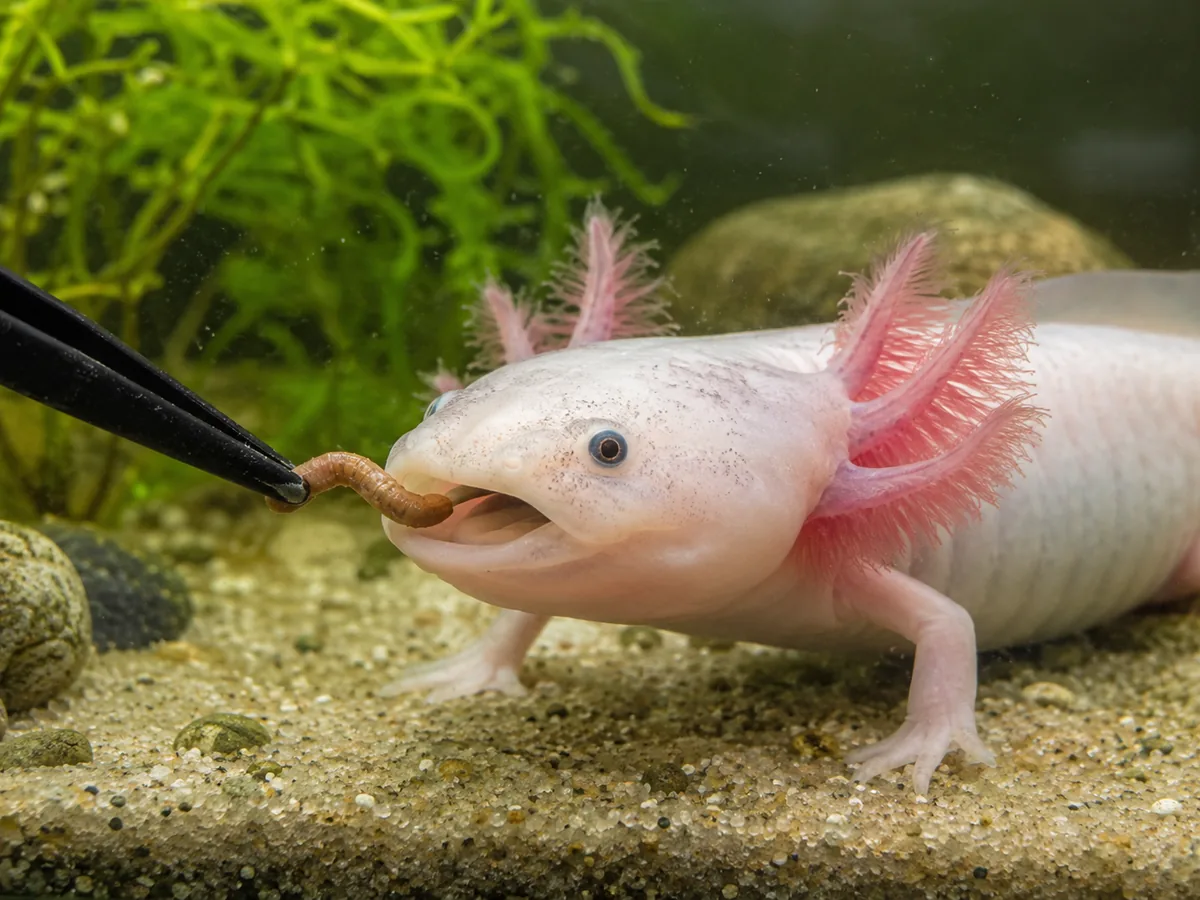
Most healthy adult axolotls do best with earthworms as a staple, with quality axolotl or carnivore pellets as a useful supplement. Feeding amount depends on age, body condition, temperature and appetite.
Best staple foods
Axolotls are carnivores. A strong feeding plan is simple, clean and nutritious. Earthworms are widely used because they are nutrient-dense and suitable for many adult axolotls. Quality sinking pellets can help when worms are unavailable or when you need a predictable supplement.
Bloodworms are popular for young animals and treats, but they should not be treated as the only long-term diet for adults. Feeder fish are usually a poor choice because they can nip gills, introduce disease, add waste and create avoidable risk.
Feeding by age
| Life stage | Typical approach | Watch for |
|---|---|---|
| Young juvenile | Smaller, more frequent meals | Growth, water fouling, food size |
| Older juvenile | Gradually larger foods | Body shape and leftover food |
| Adult | Less frequent, larger meals | Obesity, refusal, regurgitation |
There is no perfect universal schedule because metabolism changes with age and temperature. Use body condition: the belly should not be dramatically wider than the head for long periods, but the animal also should not look thin or sunken.
How much and how often: a quick reference
Use this as a starting point, then adjust to your animal's body condition — a healthy axolotl is roughly as wide as its head, with a gently rounded body and no pinched look behind the gills.
| Life stage | How often | Typical foods |
|---|---|---|
| Hatchling (first weeks) | 1–2 times daily | Baby brine shrimp, daphnia (live) |
| Juvenile (growing) | Once a day | Blackworms, chopped worm, small pellets |
| Sub-adult | Every 1–2 days | Transitioning to adult staples |
| Adult | Every 2–3 days | Earthworms and/or sinking carnivore pellets |
Amount matters as much as frequency: offer what the axolotl eats in a few minutes, then stop. Warmer water raises metabolism and appetite while cooler water lowers it, so feed a little less when the tank is cool. If your axolotl is slimming down, feed a little more often; if it is bloated or refusing food, ease off and check water and temperature first.
How to feed cleanly
Feed in a way that lets you remove leftovers. Tongs can help with worms, but avoid poking or stressing the animal. Some keepers use a feeding dish for pellets to keep food from sinking into substrate. After feeding, inspect the tank for pieces that were missed.
Foods to avoid or treat carefully
- Feeder fish, especially from unreliable sources.
- Large hard-shelled prey that can be difficult to digest.
- Foods too large to swallow safely.
- Wild-caught insects or worms exposed to pesticides.
- Human foods, cooked meats or processed scraps.
When appetite changes
One missed meal is not always an emergency, especially for an adult. Repeated refusal, weight loss, floating, fungus, curled tail, warm water or poor test results are more concerning. Before changing food repeatedly, check temperature and water parameters. Appetite is often a symptom, not the root problem.
Use the feeding schedule planner for a conservative starting point, then adjust based on the animal’s body condition.
Axolotls do not need complicated enrichment, but feeding can still be calm and engaging. Offering appropriate food with tongs, using a feeding dish, or varying safe staple foods can encourage natural interest without adding tank mates or risky décor. Keep enrichment slow, predictable and safe.
Feeding and enrichment
Leftovers are one of the easiest ways to ruin water quality. Worm pieces, pellets and soft foods can hide behind décor or sink into substrate. Feed where you can see the food, remove waste quickly and keep a simple routine. If a food consistently creates mess, it may not be worth using even if the axolotl eats it.
Leftover control
Feeding charts are starting points. Body condition tells you whether the schedule is working. A healthy axolotl should look solid but not ballooned. The body should not be dramatically wider than the head for long periods, and the animal should not look sunken behind the head or along the body. Photos taken from the same angle every few weeks can help track changes.
Body condition is better than a fixed rule
Feeding charts give a useful starting point, but no single schedule fits every axolotl. Age, size, temperature and individual metabolism all change how much an animal needs. The more reliable guide is body condition. A healthy axolotl is roughly as wide as its head, with a gently rounded body and no pinched look behind the gills. If it is becoming slim, feed a little more often; if it is bloated or refusing food, ease off and check water and temperature. Watch the animal rather than the clock, and adjust the amount and frequency to keep that steady, well-proportioned shape.
Related feeding questions
- What Do Axolotls Eat?
- How Often Should You Feed an Axolotl?
- Are Earthworms Good for Axolotls?
- Can You Overfeed an Axolotl?
- Why Is My Axolotl Not Eating?
Related: learn set up a worm bin for a free staple food supply.